
Hydrogen sulphide gives you almost no second chances. At high concentrations, one or two breaths of this gas can drop a worker mid-step. That is why the respirator rules around H2S read stricter than almost any other workplace hazard.
This guide breaks down the H2S respirator requirements in plain language: which respirator each exposure level demands, why fit testing is non-negotiable, and where workers actually learn to use the gear under pressure.
Why H2S Breaks the Normal Respirator Rules
Most airborne hazards give you time. H2S does not. The gas deadens your sense of smell within seconds at high levels, so the rotten egg warning vanishes exactly when the danger peaks.
There is a second trap. H2S is heavier than air and collects in tanks, trenches, and confined spaces, where it can displace the oxygen you need to survive. An air-purifying cartridge only filters air. It never adds oxygen. That single fact drives most of the rules below.
The Canadian Centre for Occupational Health and Safety sets the danger threshold clearly: at 100 parts per million, H2S becomes immediately dangerous to life or health, known as the IDLH level.
The Requirements by Exposure Level
Respirator selection follows the measured concentration in the air, and the jumps between levels matter. Up to 100 ppm, workers can use a supplied-air respirator with an assigned protection factor of 10, a powered air-purifying respirator with a full facepiece at APF 25, or a full-facepiece gas mask with a special H2S canister at APF 50.
At or above 100 ppm, or whenever the concentration is unknown, only two options remain: a positive-pressure self-contained breathing apparatus, or a supplied-air respirator combined with an emergency escape bottle. Unknown always counts as IDLH. Nobody guesses their way into a tank.
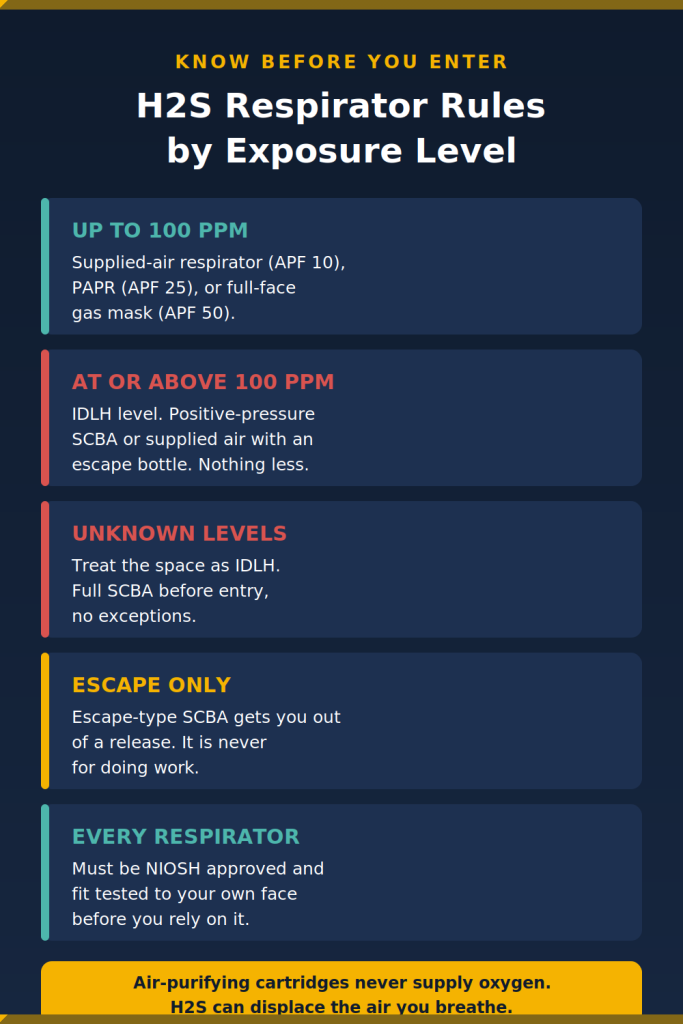
Escape respirators deserve their own mention. An escape-type SCBA exists to get you out of a release. It is never approved for performing work inside a contaminated area, no matter how short the task looks.
Fit Testing and the Clean-Shaven Rule
A respirator only protects you along its seal. OSHA’s respiratory protection standard requires a fit test before first use, whenever a different facepiece is issued, and at least annually after that. Every respirator on site must also carry NIOSH approval.
Facial hair breaks the seal, which is why sour gas sites enforce the clean-shaven rule wherever the mask meets skin. Daily shaving and a tight rubber seal are rough on your face over a long rotation, so treat skin care as part of the job. If irritation builds up, the signs covered in this guide on when your skin needs professional treatment are worth knowing.
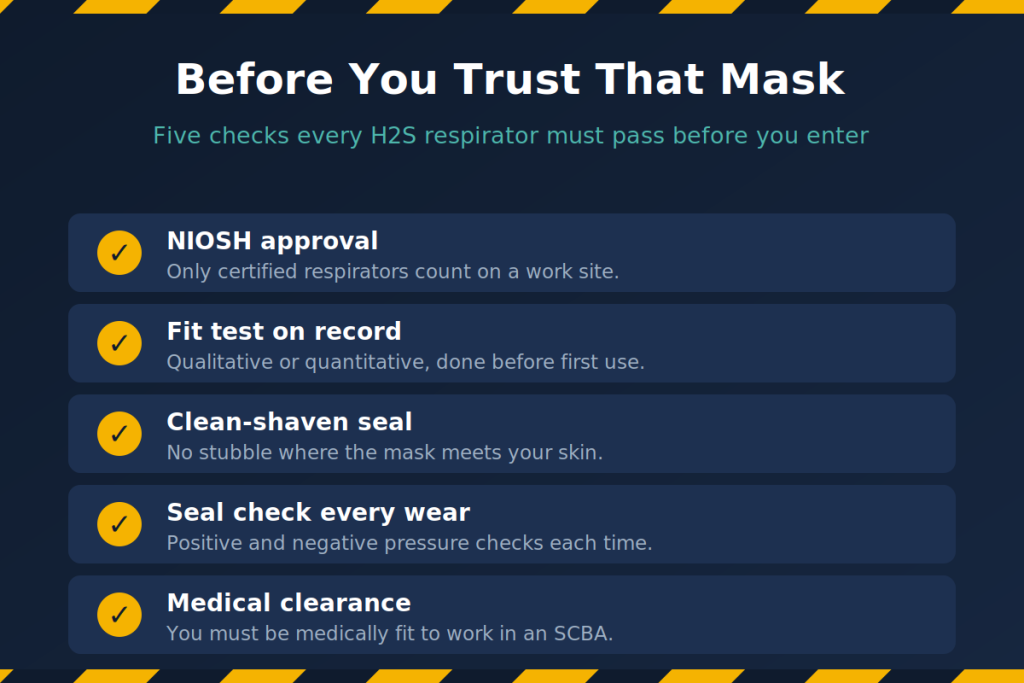
Add a seal check every single time you don the mask. Positive and negative pressure checks take ten seconds and catch the failures that fit tests miss on the day.
Training Turns Requirements Into Reflexes
Reading the rules is one thing. Donning an SCBA with your heart pounding is another. That gap is exactly what hands-on certification closes, and it is why oil and gas employers demand proof of training before anyone passes the gate.
In Alberta, crews get that proof through h2s alive training calgary programs certified by Energy Safety Canada, where workers spend a full day practicing with real breathing apparatus, gas monitors, and rescue drags before passing a supervised exam. The certificate stays valid for three years, and the muscle memory from the practical drills is the part that saves lives when a monitor alarms.
Good training also covers the seven-step initial response strategy, so workers know when to rescue and when rescuing makes a second victim. Untrained rescuers account for a painful share of H2S deaths.
Medical Fitness and Your Employer’s Duties
SCBA gear adds weight, heat, and breathing resistance, so the rules require a medical evaluation before a worker is assigned a respirator. Heart conditions, lung problems, and claustrophobia all matter here, and they are exactly the things a quick questionnaire and checkup catch.
Getting evaluated does not need to be complicated. Occupational health providers and modern walk-in clinics handle respirator medicals routinely, and this piece on finding convenient healthcare in North York shows how accessible those visits have become.
Your employer carries the rest of the load: a written respiratory protection program, a trained program administrator, respirators and training supplied at no cost to workers, and gas detection that tells everyone which exposure level they are actually facing.
FAQs
What respirator do I need for H2S?
It depends on the measured level. Up to 100 ppm allows supplied-air respirators, PAPRs, or full-facepiece gas masks with H2S canisters.
At 100 ppm or higher, or when levels are unknown, only a positive-pressure SCBA or supplied air with an escape bottle is acceptable.
Can I use a half-mask cartridge respirator for H2S?
No. H2S can displace oxygen, and cartridge respirators never supply oxygen. They also fail without warning once the cartridge saturates.
Sour gas work relies on supplied-air and SCBA systems for exactly this reason.
Do I have to be clean-shaven to wear an H2S respirator?
Yes, wherever the mask seals against your face. Stubble as short as one day’s growth can leak enough to fail a fit test.
Training courses usually allow beards in class, but the field rule is strict: no seal, no entry.
How often do I need a respirator fit test?
Before first use, then at least once a year, and again any time you switch to a different facepiece make, model, or size.
Big weight changes, dental work, or facial surgery also trigger a new fit test because they change how the mask sits.
Is H2S Alive training mandatory in Alberta?
Site operators set the rule, and across Alberta’s oil and gas industry the answer is effectively yes. Rigs, gas plants, and well sites demand the Energy Safety Canada certificate before workers step on location.
The course takes one day, includes hands-on SCBA practice, and the certificate lasts three years.